“Script of the Homeland” calligraphy exhibition opens at Azadi Tower
TEHRAN- The “Script of the Homeland” calligraphy exhibition, featuring the latest works of prominent master Kaveh Teimouri, was officially inaugurated on Tuesday at the Azadi Tower cultural complex in Tehran.
The opening ceremony was attended by distinguished figures including Deputy Culture Minister for Artistic Affairs Mehdi Shafiei, Government Spokesperson Fatemeh Mohajerani, and Mohammad Allahyari, the CEO of the Roudaki Foundation, Mehr reported on Wednesday.
Central to the exhibition is the theme of "Iran," blending classical Persian literature with contemporary national identity. Alongside Teimouri's masterful scripts, the event features artistic portraits of the martyred students of the Shajareh Tayyebeh school in Minab, bridging the gap between traditional art and recent national tragedies.
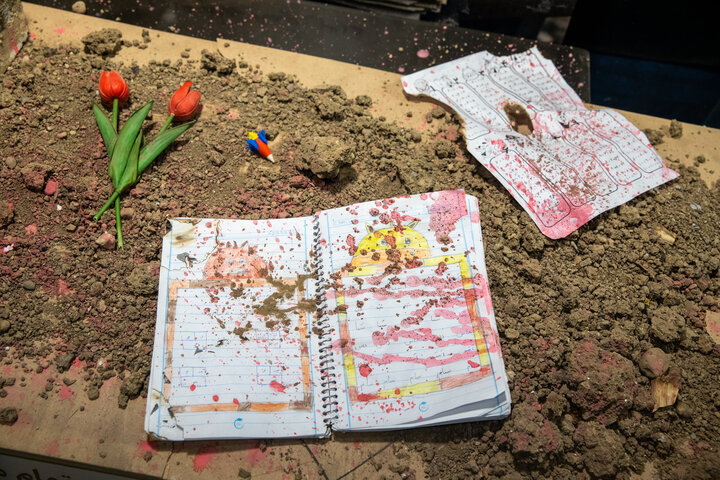
On the sidelines of the exhibition, a daily live performance recreates the tragic assault on the Minab school. Featuring child and adult actors accompanied by live music, the performance culminates in an interactive segment where attendees write a 'Final Essay' on a blackboard, honoring the children whose notebooks were stained by the blood of martyrdom.
Deputy Minister Mehdi Shafiei left a note on the board, writing: "The Minab tragedy was a 'pure wine' that unified a great society against the enemy."
The second hall of the exhibition showcases a collection of verses by Persian poets spanning a millennium, all celebrating love for the motherland. Notable pieces included calligraphic renderings of lines such as "In this soil, in this pure field, let us sow no seeds other than love," and "May the banner of Iran forever remain high and fruitful."
Teimouri, who spent countless nights crafting these pieces, also included several spiritual works centered on the names of God.
On February 28, the Shajareh Tayyebeh girls' elementary school in Minab, Hormozgan province, became the site of a devastating massacre as the United States and Israel initiated their strikes against Iran.
While dozens of girls and boys aged between 7 and 12 were beginning their lessons, the school was targeted by a missile strike that caused the building to collapse, trapping children and teachers beneath the rubble. Iranian authorities confirmed a final death toll of 168 people, with at least 95 others wounded, marking one of the most harrowing incidents of the conflict's opening day.
Despite attempts by US and Israeli authorities to distance themselves from the carnage as images of the tragedy spread across social media, detailed forensic and digital investigations have painted a starkly different picture.
An analysis by Al Jazeera’s digital investigations unit, utilizing over a decade of satellite imagery and recent video clips, revealed that the school was a clearly distinct civilian facility, separated from any adjacent military sites for at least ten years. Furthermore, witness accounts and satellite-based analyses confirmed that the school was triple tapped by three separate, deliberate strikes, leaving no doubt about the nature of the attack.
The international community has faced mounting evidence regarding the responsibility for this atrocity, with investigations from major global outlets including The New York Times, BBC Verify, CBC, and NPR all concluding that the United States was responsible for the strike.
These findings have raised fundamental questions about the intelligence used to justify the bombing, as the patterns of the strike suggest a direct targeting of a civilian educational institution. The Minab school tragedy now stands as a somber testament to the immense human cost of the aggression and a focal point for those demanding international accountability.
SAB/
Leave a Comment